Knowing what to do after a fall helps protect your health and keeps an accurate record of what happened. Here are the steps to take after a slip or trip in a store or public place.
Key takeaways
Key takeaways
– Your health comes first. Check for injuries, and get medical care if you’re hurt or hit your head.
– Report the fall to a manager or the property owner before you leave, and ask for a copy of any report.
– Take photos of what caused the fall, and note the names of employees and witnesses.
– Keep everything in one place: photos, notes, medical records, and receipts. Deadlines to act vary by state.
General information, not legal or medical advice. If you’re hurt, contact a healthcare provider. In an emergency, call 911. For advice about a possible claim, talk to a licensed attorney in your state.
Step 1: Pause and check yourself
After a fall, it’s natural to jump straight up out of embarrassment. Try not to. Take a moment to notice how you feel:
- Can you move your arms and legs normally?
- Do you have pain in your head, neck, back, hips, or wrists?
- Did you hit your head?
If you have severe pain, think you may have broken a bone, or hit your head and feel confused or drowsy, stay where you are and ask someone to call 911.
Step 2: Get medical care if you need it
Some injuries, including concussions, don’t show their full symptoms right away. Get emergency care for danger signs such as a worsening headache, repeated vomiting, slurred speech, confusion, or unusual drowsiness. Older adults and people on blood thinners should get checked promptly after any blow to the head.
Even for minor injuries, a medical visit creates a record of what happened and when. Tell the provider exactly how you fell. Our guide to common slip-and-fall injuries explains what to watch for.
Step 3: Report the fall
Tell a manager, supervisor, or property owner what happened before you leave, if you can.
- Ask them to write an incident report, and ask for a copy. If they won’t give you one, note the name of the person who took the report.
- Stick to the facts: where you fell, what you think caused it, and what injuries you noticed.
- Avoid guessing or apologizing. It’s fine to say you’re not sure yet how badly you’re hurt.
If you fell on public property, such as a city sidewalk or a government building, report it to the agency that runs it. Reporting deadlines for public property can be short.
Step 4: Photograph everything
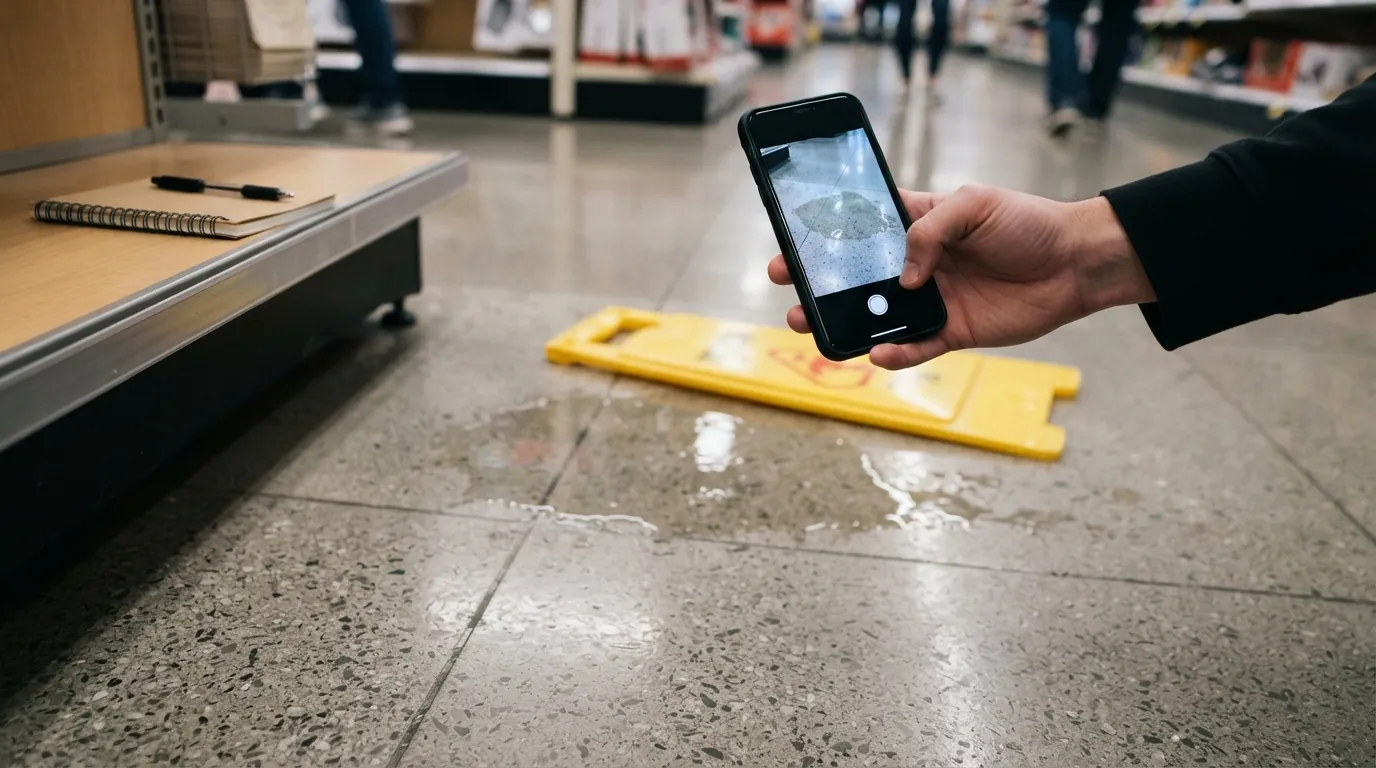
Conditions change quickly. Spills get mopped, signs get moved, and lighting gets fixed. If you’re able, or someone can help you, take photos and video of:
- the hazard itself, such as the spill, the broken step, or the raised slab, from close up and from a distance,
- whether there was a warning sign, and where it was,
- the lighting and the surrounding area,
- your shoes, and
- any visible injuries, and again over the following days.
Step 5: Gather names and details
Write down, or record on your phone:
- the date, time, and exact location,
- the names and roles of employees you spoke with,
- names and contact details for any witnesses, and
- whether there are security cameras nearby.
Step 6: Keep your records together
Start a simple folder, paper or digital, with:
- photos and videos,
- your notes from the day,
- a copy of the incident report,
- medical records, bills, and receipts,
- notes on time missed from work, and
- a short daily log of symptoms and how the injury affects you.
Keep the clothes and shoes you wore, unwashed and unrepaired, in case they’re needed later.
Step 7: Be careful what you sign or post
- Read anything carefully before signing it, and don’t sign anything you don’t understand.
- An insurance company may contact you. You don’t have to give a recorded statement right away.
- Think twice before posting about the fall on social media.
Step 8: Know that deadlines apply
Every state has a statute of limitations, a deadline for filing an injury claim, and the time limits differ from state to state. Claims involving government property often require formal written notice within a much shorter time. If you’re considering a claim, talk to a licensed attorney in your state early. Our guide to premises liability basics explains how property owners’ responsibilities generally work.
If you fell at work
Falls at work are usually handled through workers’ compensation, which has its own reporting rules. Report the injury to your employer right away and follow their procedure.
A quick checklist
- Checked for injuries, and got medical care if needed
- Reported the fall and got a copy of the report, or the name of who took it
- Photos of the hazard, the area, signs, lighting, shoes, and injuries
- Names of employees and witnesses
- Notes on date, time, and location
- Folder with records, bills, and a symptom log
- Clothes and shoes kept as they were
Sources
- Centers for Disease Control and Prevention: Signs and symptoms of mild TBI and concussion
- Legal Information Institute, Cornell Law School: Statute of limitations